
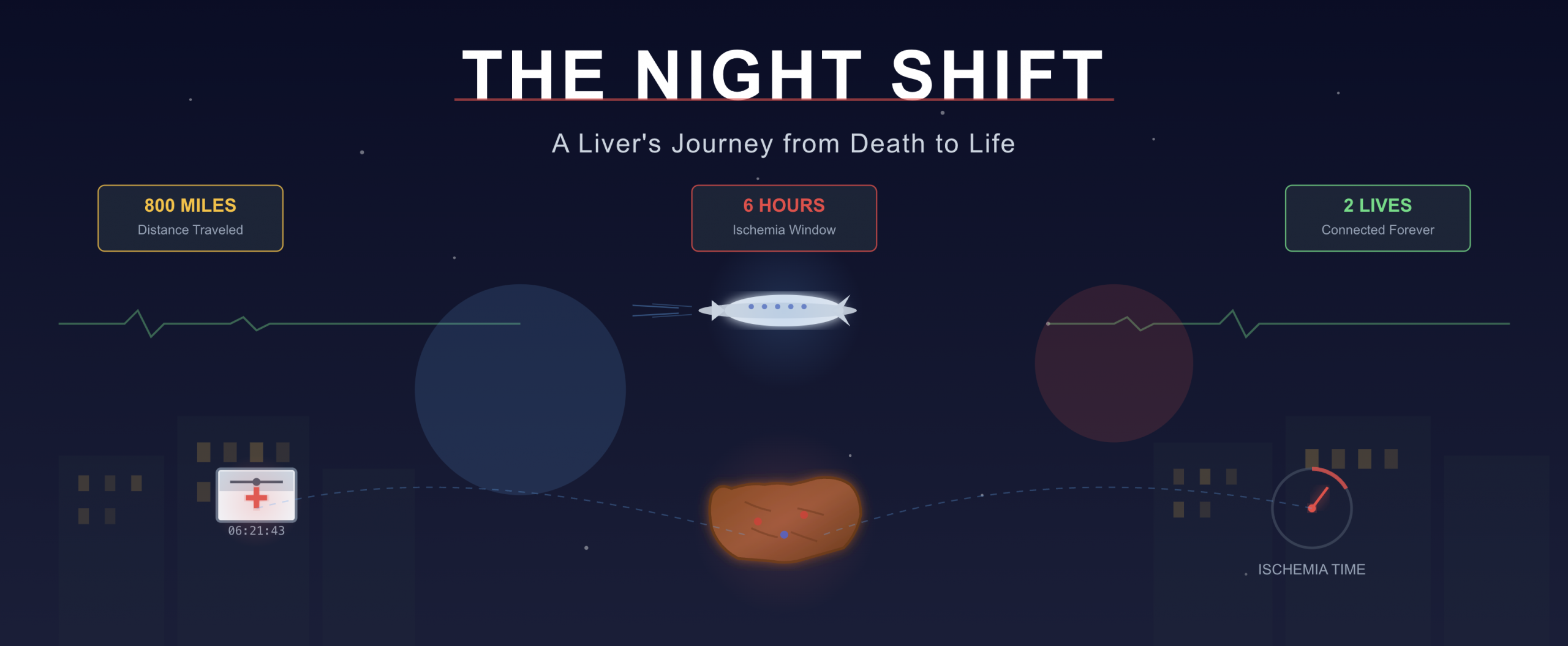
Prologue: The Phone Rings at 10:47 PM
There’s a peculiar mathematics to organ transplantation that most people never consider. Somewhere, someone must die—suddenly, tragically, often violently—for someone else to live. A motorcycle accident in Ohio saves a schoolteacher in Seattle. A stroke in the Midwest becomes a second chance in California. Death and salvation, existing in the same breath, separated by nothing more than a few hours of flying time and the skill of surgeons who operate in both worlds simultaneously.
This is not metaphor. This is Tuesday night.
When Dr. Johanna Lee’s phone rang that October evening, she was already halfway to the door. Twenty years of transplant surgery had trained her body to respond before her conscious mind fully processed the words: “We have a match.” Within an hour, she’d be in an ambulance. Within two, she’d be wheels-up in a private charter. And within five, she’d be elbow-deep in a stranger’s abdomen, harvesting an organ that would be implanted into another stranger before sunrise.
The liver she would retrieve weighed exactly three pounds. It had filtered toxins, synthesized proteins, and stored energy for a man named John for forty-seven years. In six hours, it would do the same for a woman John would never meet, whose name he would never know, in a city he had never visited.
This is the story of that night. But it’s also the story of how we got here—how humanity learned to transfer life itself across the boundary of death, and what it cost us to figure it out.
Part I: The Logistics of Mortality
The Waiting Game
At any given moment in America, approximately 10,000 people are waiting for a liver. Most will wait months. Some will wait years. About 1,700 will die waiting.
The list is not first-come, first-served. It’s not a queue at the DMV. It’s an algorithm—the Model for End-Stage Liver Disease (MELD) score—that calculates how close you are to death. The sicker you are, the higher you climb. In a system where organs are scarce and demand infinite, we’ve chosen to save those closest to the edge.
This creates a perverse incentive structure. Get too sick, and you might be too weak to survive the surgery. Stay too healthy, and you’ll never reach the top of the list before your liver fails completely. It’s a cruel optimization problem where the variables are human lives and the margins impossibly thin.
When John—brain-dead in a Midwestern hospital—entered the national database at 9:23 PM, an algorithm began calculating compatibility matches across fourteen states. Blood type. Body size. Geographic proximity. Tissue typing. Urgency scores. Within seventeen minutes, the system had identified its best candidate: a woman we’ll call Sarah, whose MELD score of 38 meant she had weeks, maybe days, left to live.
The notification went out simultaneously to three teams: the procurement coordinators who would facilitate the retrieval, Dr. Lee’s transplant team who would harvest the organ, and Dr. Gibbs’s team who would prepare the recipient. From that moment, the clock was ticking. A liver can survive outside the body for approximately six to nine hours before cellular decay makes it unusable. Every minute mattered.
This is modern medicine’s most elaborate relay race, where the baton is a human organ and dropping it means someone dies.
The Philosophy of Death
John never signed an organ donor card. He never checked the box at the DMV. In the final accounting of his life’s paperwork, there was no explicit instruction about what should happen to his liver, his kidneys, his heart, his lungs, or his corneas after brain death.
But John also had no family who claimed him. No next of kin stepped forward. The people listed in his medical records—names scrawled years earlier during some intake form he’d probably rushed through—told hospital staff they’d never heard of him. So the decision fell to the county coroner, who, under the Anatomical Gift Act, possesses the legal authority to donate unclaimed organs.
This raises uncomfortable questions we’d rather not contemplate.
In Europe, the presumption is reversed. Your organs belong, by default, to the collective. Unless you explicitly opt out—registering your refusal in a national database—doctors have the legal right to harvest whatever they need when you die. The philosophical underpinning is communitarian: your body is on loan from society, which has a claim to its parts when you’re done with them.
America’s system operates on opposite principles. Your body is yours. Donation is gift, not obligation. It’s a libertarian philosophy embedded in legislation, rooted in the belief that bodily autonomy survives death and that the state cannot conscript your organs without consent.
But what happens when there’s nobody to give consent? When social isolation—a growing epidemic in modern America—means you die as you lived: alone, unclaimed, unmissed? The coroner’s signature transforms a question of philosophy into bureaucratic procedure. John’s liver became available not because he wanted to save a life, but because nobody stepped forward to say he didn’t.
I find this simultaneously pragmatic and haunting. We’ve created a system that harvests the organs of the forgotten, the abandoned, the friendless. Is this ethical efficiency or dystopian opportunism? I genuinely don’t know. What I do know is that Sarah—the recipient—didn’t ask these questions when the hospital called. She asked only one thing: “When do I come in?”
The Choreography of Procurement
The King Air 350 touched down at 12:47 AM on a private airstrip that serviced exactly one kind of emergency: this one. Dr. Lee, her resident Julia, and Trudy—the Organ Recovery Coordinator—deplaned into a waiting SUV that would take them to a hospital none of them had visited before.
This is standard. On procurement runs, you’re always going somewhere new, meeting surgical teams you’ll never work with again, navigating unfamiliar hospital corridors at 1 AM while carrying suitcases full of instruments and an empty cooler that looks absurdly oversized until you realize it needs to hold a three-pound organ packed in enough ice to keep it viable for a five-hour journey.
By the time they arrived, the operating room was already alive with motion. Scrub nurses laid out surgical instruments in precise rows. Anesthesiologists monitored vitals on screens. Technicians prepared preservation solutions. And at the center of it all: John, looking for all the world like a man peacefully sleeping, his chest rising and falling in the mechanical rhythm of a ventilator.
Brain death is one of medicine’s strangest concepts. John’s heart still beat. His kidneys still produced urine. His liver still metabolized toxins. His skin was warm. His fingernails would continue growing for days. Every cell in his body—except those in his brain—was alive, functional, doing exactly what it had always done.
But John was gone. The electroencephalogram showed no brain activity. No reflexes remained. No awareness existed behind those closed eyes. Medical ethicists spent decades in the 1960s and 70s hammering out the criteria for brain death precisely so we could navigate this philosophical minefield: when is a person no longer a person, even when their body refuses to acknowledge it?
The practical answer: when two independent physicians confirm irreversible cessation of all brain function, including the brainstem. The philosophical answer remains contested by theologians, ethicists, and families who see that beating heart and cannot reconcile it with “dead.”
For Dr. Lee, such debates were background noise. She had a job to do, and it required treating John’s body with a particular kind of reverence—not as a corpse, not as a patient, but as something in between. A vessel. A gift-in-progress.
Before the first incision, she led a moment of silence. No religious invocation. No poetry. Just sixty seconds where everyone in that operating room acknowledged that what they were about to do mattered in ways that transcended the technical. Then she picked up the bovie, and the surgery began.
Part II: The Architecture of Life’s Filter
What a Liver Actually Does
Before we watch Dr. Lee harvest John’s liver, we need to understand what makes this organ so remarkably necessary that its failure justifies the moral complexity of transplantation.
The liver is a metabolic genius—a three-pound chemical factory performing over 500 distinct functions simultaneously. Let me give you a sense of the scope:
As a detoxifier, it neutralizes everything from alcohol to acetaminophen, from environmental toxins to the waste products of your own metabolism. It transforms ammonia (toxic) into urea (excretable). It breaks down old red blood cells and recycles their iron. It processes every drug you take, every pesticide on your vegetables, every preservative in your processed food.
As a manufacturer, it produces bile—the green-yellow substance that emulsifies fats so your intestines can absorb them. It synthesizes cholesterol (yes, your body makes its own, regardless of diet) and converts it into hormones, vitamin D, and cell membranes. It creates albumin, the protein that keeps fluid in your blood vessels instead of leaking into your tissues.
As a warehouse, it stores glucose as glycogen, releasing it when your blood sugar drops. It stockpiles vitamins A, D, E, K, and B12. It maintains reserves of iron and copper.
As a metabolic conductor, it regulates blood clotting by producing fibrinogen, prothrombin, and most of the other factors that prevent you from bleeding out when you get a paper cut. It balances the proteins that control inflammation. It manages the delicate equilibrium between coagulation and dissolution that keeps your blood flowing but not hemorrhaging.
When a liver fails, all of this stops. You can’t detoxify. You can’t digest fats. Your blood sugar becomes erratic. Toxins accumulate in your bloodstream and cross into your brain, causing hepatic encephalopathy—a state of confusion that progresses to coma. Your blood stops clotting properly, leading to spontaneous bleeding. Fluid leaks from your blood vessels into your abdomen, causing massive swelling. Your skin and eyes turn yellow as bilirubin accumulates.
And here’s the cruelest part: unlike kidneys, which can be replaced by dialysis machines, there is no artificial liver that can sustain you long-term. When your liver fails, your only options are transplant or death.
Sarah, the woman waiting in surgery across state lines, had already experienced most of these symptoms. Her liver—destroyed by decades of hepatitis C infection—had progressed to cirrhosis, where functional tissue is replaced by scar tissue that can’t perform any of the liver’s jobs. Her abdomen was distended with fluid. Her mind drifted in and out of confusion. She bled easily from her gums, her nose, anywhere blood vessels ran close to the surface.
She needed John’s liver not to improve her quality of life. She needed it to continue having a life at all.
Part III: The Surgery
Act One: Assessment
Dr. Lee’s first incision ran from John’s collarbone to his pubis—a long vertical line that, intersected by a horizontal cut at the belly button, formed a crucifix. The smell hit immediately: burning hair and flesh, an odor that surgery veterans uncomfortably describe as resembling barbecue. The bovie’s electrical current cut through skin while simultaneously cauterizing blood vessels, turning what would be a catastrophic hemorrhage into controlled, nearly bloodless dissection.
Layers revealed themselves: skin, subcutaneous fat (yellow and glistening), fascia (white and fibrous), muscle (striated and dense), and finally the peritoneum—the membrane that, when breached, released the contents of the abdomen into the light.
The liver appeared first. Massive. Rust-colored with a purple sheen. Spanning the entire right upper quadrant of the abdominal cavity, tucked partially beneath the rib cage. In textbooks, livers are clean, isolated, labeled with neat arrows. In reality, the liver is embedded in a web of connective tissue, surrounded by other organs, entangled with blood vessels that branch like river deltas.
Dr. Lee’s assessment began with touch. She passed her gloved hands across the liver’s surface, feeling for texture, consistency, abnormalities. “A good liver,” she’d told me earlier, “should feel like a stingray—smooth, supple, soft.” She examined the edges, which should be sharp and defined, not rounded and bumpy (which would indicate cirrhosis or fatty infiltration).
This is the moment of truth. All the logistics—the flights, the coordination, the recipient being prepped in another operating room 800 miles away—hinge on this tactile assessment. If the liver is diseased, too fatty, too damaged, everything stops. The recipient goes home. The surgical teams disperse. The waiting begins again.
Dr. Lee took photos with her iPhone and texted them to Dr. Gibbs. The response came within ninety seconds: “Looks good. Proceed.”
Act Two: Liberation
The warm dissection is surgery as archaeology—carefully excavating an organ from the body that has housed it since birth, preserving every critical connection while severing everything else.
Dr. Lee began with the falciform ligament, a thin membrane that anchors the liver to the anterior abdominal wall. Then the triangular ligaments on each side. Then the coronary ligaments connecting the liver to the diaphragm. Each was divided carefully, because beneath these seemingly simple attachments ran blood vessels that, if nicked, would cause John to bleed out before the liver could be recovered.
“Replaced left,” she announced to Julia, her resident. She’d found an anatomical variation—the left hepatic artery, instead of branching from the proper location on the common hepatic artery, emerged directly from the left gastric artery. This occurs in about 10% of people. Textbooks show you “normal” anatomy. Reality shows you that only about half of all humans have textbook-normal liver vasculature. The rest have variations that surgeons must identify, map, and preserve.
This is why procurement requires human surgeons rather than robots. The anatomy is too variable. The stakes too high. You need someone who can read the landscape, adapt in real-time, make judgment calls when the unexpected appears.
Julia, meanwhile, wrestled John’s colon out of the abdomen—a pink, undulating mass that needed to be moved aside so Dr. Lee could access the portal vein, which brings blood from the intestines and spleen into the liver. She tied it with silk suture and cannulated it, inserting a catheter through which preservation solution would eventually flush.
An hour passed. The dissection continued. Nurses at the periphery chatted quietly, waiting for their moment to act. One invited me to peer into John’s chest cavity, where his sternum had been sawed open to expose his heart—still beating, wringing itself out rhythmically, slapping against lungs that looked like raw meat.
“Why hasn’t the heart stopped?” I asked, knowing the answer but needing to hear it said aloud.
“He’s brain-dead,” the nurse said. “But the heart doesn’t need the brain to beat. It has its own electrical system.”
This is the paradox of brain death that families struggle with. Every folk intuition about death—the stopping of the heart, the cessation of breath, the cooling of skin—fails here. John’s body exhibited none of death’s usual signs. And yet he was, by every medical and legal definition, dead.
Act Three: The Cross-Clamp
The most dramatic moment in any procurement is the cross-clamp—the instant when the surgeon severs all blood flow to the organ and flushes it completely clean.
Dr. Lee clamped the aorta above the heart, preventing blood from pumping downward. She nicked the inferior vena cava—the massive vein that returns blood from the lower body to the heart. She inserted cannulas into both the aorta and portal vein.
Then she gave the signal.
Chaos erupted in choreographed precision. As John’s blood drained from the open vena cava, nurses suctioned it into a collection machine while simultaneously stuffing his abdomen with crushed ice. The preservation solution—cold, clear, and loaded with nutrients and antioxidants—flushed through the hepatic artery and portal vein, pushing out every last drop of blood.
The liver transformed. The rust-purple color drained away, replaced by a pale gray. John’s face—which had remained pink throughout the surgery—went gray as well, the pallor climbing from his chin to his forehead until only the very top of his scalp retained any warmth.
In ninety seconds, John went from appearing peacefully asleep to unmistakably dead.
Dr. Lee worked quickly now. She divided the hepatic artery, the portal vein, the hepatic veins, and the bile duct, lifting the liver—along with a lengthy segment of the inferior vena cava and a patch of the diaphragm—out of John’s body and into a sterile basin.
Three pounds. That’s all a liver weighs. Three pounds of tissue that, when functioning, keeps you alive, and when failing, kills you slowly and agonizingly.
Trudy triple-bagged it, submerged it in preservation solution, packed it in ice, and sealed it in the cooler. From this moment forward, the clock was running. Six to nine hours before ischemic injury—the damage caused by lack of oxygen—made the organ unusable.
We stripped off our gowns and ran.
Part IV: The History We Carry
The Seamstress Who Changed Surgery
The liver now traveling in a cooler on a King Air 350 at 15,000 feet represented not just one man’s gift to one woman, but the culmination of centuries of surgical innovation, ethical debates, and spectacular failures.
The history of transplantation is a graveyard of ambition. For every success, there are dozens of patients who died on operating tables, surgeons who were sued, techniques that were abandoned after catastrophic results.
Consider this: In the 1960s and 70s, desperate parents brought dying children to surgeons who attempted liver transplants with a 100% mortality rate. Every single patient died. Some during surgery. Some days later from bleeding. Some weeks later from rejection. And yet surgeons kept trying, kept refining, kept believing that the next patient might survive.
The technical breakthrough that made any of this possible came not from a surgeon, but from an embroideress named Marie-Anne Leroudier.
In 1901, surgical trainee Alexis Carrel needed to learn vascular anastomosis—the technique of sewing blood vessels together so precisely that blood could flow through the connection without clotting or leaking. The sutures of his era were too thick, the needles too large, the techniques too crude. Blood vessels would tear, buckle, or thrombose.
Carrel’s mother sent him to Leroudier, who embroidered gowns for Parisian high society. She taught him to sew one-handed, to use thread efficiently, to pierce material so delicately it wouldn’t tear. She had him practice on cigarette papers until he could feel, in his fingertips, the precise moment before the material would give way.
Leroudier’s name appears in almost no surgical histories. She received no recognition, no awards, no mention in Carrel’s Nobel Prize citation in 1912. And yet her techniques—refined from fashion to flesh—are still used today. Every time a surgeon connects an artery, they’re employing skills descended from a woman who spent her life sewing dresses.
This pattern repeats throughout medical history. Surgeons learned from their mothers, sisters, and wives before medical schools taught suturing. Rosalind Franklin’s X-ray crystallography revealed DNA’s structure, but Watson and Crick got the Nobel. Countless contributions from women, marginalized people, and forgotten technicians form the foundation on which celebrated men built careers.
When I watch Dr. Lee’s hands move—precise, efficient, economical with motion—I think about all the invisible teachers whose techniques have been passed down, refined, and attributed to others. The history of transplantation is not just the story of famous surgeons. It’s the story of embroiderers and wet nurses, of anatomists who procured their cadavers from grave robbers, of desperate families who consented to experimental surgeries that had never succeeded before.
The Children Who Died First
Thomas Starzl performed the first human liver transplant in 1963 on a three-year-old named Bennie. The boy had biliary atresia—a condition where bile ducts fail to develop properly, causing the liver to poison itself with its own waste.
Starzl’s team had successfully completed 200 liver transplants on dogs. They had refined their technique, practiced their timing, prepared for every complication they could imagine.
Bennie bled to death on the operating table.
His liver was so scarred that the blood pressure between it and his intestines was catastrophically high. His blood wouldn’t clot because his dying liver couldn’t produce clotting factors. The surgery that should have taken six hours took fourteen. They transfused thirty-five units of blood—more than ten times the volume of Bennie’s entire circulatory system. Nothing worked.
A nurse washed his small body and wrapped it in a white sheet while crying.
That year, Starzl attempted four more liver transplants. Four more deaths. The longest any patient survived was twenty-three days. Similar failures in Boston and Paris led to a five-year moratorium on human liver transplants. The procedure seemed impossible. Too much bleeding. Too much rejection. Too many ways for everything to go catastrophically wrong.
But Starzl kept working. He transplanted livers into dogs, pigs, monkeys. He experimented with immunosuppressants. In 1964, he produced the first long-term survivor after a liver transplant: a dog that lived twelve years before dying of old age.
The key was azathioprine, an immunosuppressant that prevented the recipient’s immune system from attacking the foreign organ. But Starzl noticed something curious: in liver transplants, unlike kidney transplants, he could eventually stop the immunosuppressants entirely, and the liver would still survive. The liver, it turned out, was “immunologically privileged”—somehow less vulnerable to rejection than other organs.
Armed with this knowledge, Starzl returned to human patients in 1967. A 19-month-old named Julie received a liver transplant and survived for a year. Her cancer eventually returned, but the liver itself worked. The surgery was possible.
By 1980, with better immunosuppressants and refined surgical techniques, the one-year survival rate reached 70%. Today, it exceeds 90%.
But we got there by sacrificing children. By performing experimental surgeries on dying patients who had no other options. By pushing forward even when the mortality rate was 100%, because the alternative—doing nothing—meant certain death anyway.
This is the uncomfortable truth about medical progress. We advance by learning from failure, and failure, in surgery, means someone dies. Every technique Dr. Lee used tonight was developed through trial and error, paid for in the lives of patients whose names we’ll never know.
The Xenotransplantation Dream (and Nightmare)
Humans have been trying to transplant animal organs into people for centuries, with predictably horrific results.
In 1667, Jean-Baptiste Denis transfused lamb blood into a feverish boy, who survived. Emboldened, Denis tried five more transfusions that year. Three patients recovered. Two died. When Antoine Mauroy died after three separate transfusions, Denis was charged with murder. Though eventually cleared (Mauroy’s wife had poisoned him), the scandal prompted bans on transfusions across Europe for 150 years.
The 19th century saw an explosion of xenograft attempts:
- An English doctor grafted frog skin onto a burned boy
- A French physician tried transplanting dog belly skin onto an ulcerated hand (it failed, he claimed, because the dog wouldn’t stay still)
- A ten-year-old Chicago girl with severe burns was strapped to a sheep’s belly until her skin could vascularize into the graft (she died, but doctors tried the same thing again with rabbits, cats, rats, chickens, and pigeons)
- Teeth from dogs, sheep, goats, and baboons were jammed into human gums
- Bits of chimpanzee and baboon testicles were transplanted into elderly men who’d “lost their zest for life”
- Kidneys from lambs and dogs were transplanted into desperate patients (all died)
Every single one of these attempts failed, because surgeons didn’t yet understand immunology. The human immune system evolved specifically to recognize foreign proteins and destroy them. An animal organ is about as foreign as it gets.
And yet, the dream persists. In 2022, surgeons at the University of Maryland transplanted a genetically modified pig heart into a 57-year-old man named David Bennett, who survived for two months before dying from a pig virus that had contaminated the organ. In 2024, a Massachusetts man received a gene-edited pig kidney that functioned for seven weeks before failing.
Why do we keep trying? Because the math is stark: in America alone, over 100,000 people wait for organ transplants. About 6,000 die each year waiting. If we could create a renewable supply of animal organs—pigs, specifically, whose organ sizes match humans’—we could eliminate the waiting list entirely.
The technical challenges are immense. Pig organs carry viruses that can infect humans. The human immune system attacks pig tissue even more aggressively than human tissue. The organs don’t always fit or function correctly.
But genetic engineering is advancing rapidly. We can now delete pig genes that trigger human immune responses and insert human genes that help disguise the pig organ as “self.” CRISPR technology allows us to edit dozens of genes simultaneously. AI-powered protein prediction helps us understand which modifications might work.
Within our lifetimes, xenotransplantation may become routine. Or it may remain a promising idea that never quite works. Either way, John’s liver—fully human, immediately compatible, harvested from a brain-dead donor—represents the system we have now. Imperfect. Ethically complicated. But functional.
Part V: The Implantation
The Recipient Wakes
Sarah had been waiting three years for a liver. Three years of progressive decline, of hospitalizations, of watching her body betray her in small and large ways.
When the call came at 11:30 PM—”We have a liver. Come to the hospital immediately”—she’d been through two false alarms before. Twice, she’d driven to the hospital, been prepped for surgery, only to have the transplant cancelled when the donor organ proved unsuitable or when someone sicker bumped her from the list.
This time, though, everything aligned. By the time Dr. Lee’s plane landed, Sarah was already on the operating table, opened up, her diseased liver partially removed.
Dr. Gibbs, the implanting surgeon, had been performing “the hepatectomy”—removing Sarah’s failed liver—for three hours. Unlike procurement, where the surgeon can take their time exploring anatomy, recipient hepatectomy is a race against bleeding. Sarah’s liver was so cirrhotic that the scar tissue had created abnormal blood vessels everywhere—fragile, dilated, prone to rupture. Every cut triggered hemorrhage. Every connection that was severed had to be immediately controlled or she’d bleed out.
The surgery required two teams: one removing the old liver, one preparing the new one. As Dr. Gibbs extracted Sarah’s cirrhotic liver—shrunken, nodular, useless—Dr. Lee was in an adjacent room preparing John’s liver for implantation.
She trimmed excess tissue, checked every blood vessel, ensured the portal vein, hepatic artery, and bile duct were all cleanly cut and ready to connect. She examined it one final time under surgical lights, looking for any signs of damage, any tears, anything that might compromise function.
Then she carried it to the operating table and lowered it into the empty space where Sarah’s liver had been.
The anastomosis—the connection of blood vessels—had to be perfect. Three critical connections:
- The portal vein, which brings blood from the intestines to the liver. Get this wrong and blood backs up, causing catastrophic intestinal damage.
- The hepatic artery, which supplies oxygenated blood. If this clots or leaks, the liver dies from lack of oxygen.
- The bile duct, which drains bile from the liver to the intestine. If this fails, bile leaks into the abdomen, causing peritonitis and sepsis.
Each connection requires microsurgical precision. The vessels are sewn together with sutures finer than human hair, using techniques descended from Marie-Anne Leroudier’s embroidery lessons over a century ago. One misplaced stitch, one moment of imprecision, and the entire transplant fails.
Dr. Gibbs worked methodically. Portal vein first—six hours after procurement, still well within the safe ischemia window. Then hepatic artery. Then bile duct. Finally, he unclamped the vessels.
This is the moment of truth. When blood flows into the transplanted liver for the first time, you learn immediately whether you’ve succeeded. If the anastomoses leak, blood fills the abdomen. If they’re too narrow, the liver won’t perfuse properly. If a vessel is twisted or kinked, everything fails.
The liver pinkened. The surface glistened. The color transformed from gray-dead to living-rust in seconds. No leaks. No complications. The organ was working.
Within minutes, the liver began producing bile—bright green fluid dripping from the bile duct, proof that the organ was already performing its metabolic functions. Within hours, it would be producing clotting factors, synthesizing proteins, filtering toxins.
John’s liver, which had served him for forty-seven years, would now serve Sarah for—if all went well—twenty or thirty more.
Part VI: The Questions We Can’t Answer
What Does It Mean to Carry Someone Else’s Organ?
Sarah will spend the rest of her life on immunosuppressants—drugs that prevent her body from recognizing John’s liver as foreign and trying to destroy it. She’ll take them every day. She’ll have blood tests every few months to ensure the drugs are at therapeutic levels. She’ll be more vulnerable to infections, to certain cancers, to kidney damage from the medications themselves.
But she’ll be alive.
Does she owe John something? Legally, no. The organ was a gift with no strings attached. Ethically? The question gets murkier. Sarah will never know John’s name (organ donation is anonymous by design). She can write a letter to his family through the organ procurement organization, but they may never respond. Many don’t.
Some recipients describe feeling a connection to their donors—dreams about them, intuitions about their personalities, a sense of carrying not just an organ but a piece of someone’s soul. This is almost certainly psychological projection, but it’s real to the people experiencing it.
Others treat the transplanted organ as purely mechanical—a replacement part, like a new carburetor in a car, with no more emotional significance than that.
The liver itself, of course, has no memory. It doesn’t carry John’s personality or preferences. Cells are constantly dying and being replaced, and within months, almost every cell in the transplanted liver will be new, built from Sarah’s nutrients, regulated by Sarah’s hormones, integrated into Sarah’s metabolism.
And yet. John’s liver will retain his DNA. Every cell will carry his genetic code, not Sarah’s. If Sarah has children after the transplant, they’ll carry her DNA, but her liver won’t. She is, in a very literal sense, a chimera—an organism containing cells from two different individuals.
The AI Revolution in Transplant Medicine
The field of transplantation is on the cusp of transformation, and artificial intelligence is driving it.
Consider the matching algorithm. Right now, MELD scores and basic compatibility criteria determine who gets which organ. But what if AI could predict, with 90% accuracy, which specific donor liver would function best in which specific recipient? Not just blood type and size, but immunological compatibility at the molecular level, predicted longevity, likelihood of rejection?
Machine learning models trained on thousands of transplant outcomes can identify patterns human doctors miss. They can predict which recipients are most likely to have complications, which donors’ organs will perform better than their surface characteristics suggest, which drug combinations will work best for which patients.
In 2024, researchers at Stanford developed an AI system that analyzes donor liver biopsies and predicts post-transplant function with 87% accuracy—better than experienced transplant surgeons’ visual assessments. The AI identified microscopic features of cellular stress, fat infiltration, and fibrosis that human eyes couldn’t reliably detect.
AI is also revolutionizing organ preservation. The traditional method—packed in ice, transported in a cooler—causes ischemic damage that limits how long organs can survive outside the body. New perfusion machines keep organs “alive” during transport, pumping oxygenated blood through them at body temperature. AI systems monitor dozens of parameters in real-time, adjusting flow rates, oxygen levels, and nutrient composition to maintain optimal organ health.
The result? Livers that can survive twelve to twenty-four hours outside the body instead of six to nine. That means organs can be transported farther, allowing better matching. It means surgeries don’t have to happen in the middle of the night. It means fewer organs are discarded as non-viable.
Even more exciting: AI-designed synthetic scaffolds that could be seeded with a recipient’s own cells to grow custom organs. Researchers have already created functioning mini-livers in laboratories using 3D bioprinting and stem cells. These aren’t transplant-ready yet, but within twenty years? Thirty? We might eliminate the need for donors entirely.
The convergence of structural biology, genetic engineering, machine learning, and regenerative medicine is creating possibilities that seemed like science fiction a decade ago. The liver Sarah received tonight represents the state of the art in 2025. But the livers transplanted in 2045 might be grown in bioreactors, optimized by AI, and perfectly matched to their recipients from the start.
The Ethics of Scarcity
Every transplant system is ultimately a system for rationing scarce resources. We have more people who need organs than organs available. Someone has to decide who lives and who dies.
Right now, that decision is made by algorithm—the MELD score prioritizes the sickest patients. But is that the right approach? Should we prioritize patients most likely to survive longest post-transplant? Youngest patients who’ll get the most years? Those with dependents? Those who’ve waited longest?
Every choice embeds values. Every system advantages some patients and disadvantages others.
Consider: A 65-year-old recovering alcoholic with liver failure competes for an organ against a 40-year-old with genetic disease. Who should get it? The younger patient will likely get more years of life from the transplant. But the older patient’s disease wasn’t “their fault” in the way alcoholism is often perceived to be. Does moral culpability matter in medical triage?
For decades, alcoholics were deprioritized for liver transplants. The thinking: they destroyed their own livers through voluntary behavior, so why give them a scarce organ when someone with “innocent” disease is waiting? This changed in the 1990s when research showed that recovered alcoholics had similar post-transplant outcomes to other patients, and that addiction is a disease, not a moral failing.
But the underlying question persists across medicine: Should lifestyle choices affect access to scarce resources? Do smokers with lung cancer deserve less priority than non-smokers? Do the obese with heart disease? Do people who refuse vaccines during pandemics?
These are not abstract philosophical debates. They’re decisions made daily by transplant committees, insurance companies, and triage protocols. And they reveal our deepest beliefs about personal responsibility, desert, fairness, and the value of different lives.
I don’t have answers. I don’t think anyone does. What I do know is that Sarah—the woman who received John’s liver tonight—deserved that organ no more and no less than the nine thousand other people waiting. The algorithm decided she was sicker, closer to death, and therefore most urgent. Is that just? I don’t know. But it’s the system we have, and she’s alive because of it.
Part VII: The Dawn
What Happens When the Sun Comes Up
By 6:47 AM, Sarah’s incision was being closed. The new liver, tucked into her abdomen, was already working—producing bile, synthesizing proteins, filtering toxins. Her skin, which had been yellowed with jaundice for months, would gradually return to normal color as bilirubin levels dropped.
She wouldn’t wake for several hours. When she did, she’d be in the ICU, intubated, catheterized, with drains protruding from her abdomen to remove excess fluid. She’d be in pain. She’d be confused. She’d wonder if it had worked.
It would take days before the blood tests confirmed what the surgical team already knew: the liver was functioning. It would take weeks before she could eat solid food, walk without assistance, or think clearly through the brain fog of post-surgical trauma and medications. It would take months before she felt remotely normal.
But she’d be alive. And that liver—John’s liver—would likely outlast her natural lifespan if she took her medications, avoided infections, and came to clinic appointments for monitoring.
Dr. Lee, meanwhile, was already on another plane. Two more procurements scheduled that day—one in Michigan, one in Arizona. Both livers. Both midnight surgeries. Both sprints against ischemia time and the logistics of geography.
This is the reality of transplant surgery. It’s not one dramatic operation. It’s a continuous cycle of death and resurrection, coordinated across time zones, executed by surgeons who rarely sleep and teams who meet once and never again.
The Statistics We Don’t Talk About
Let me give you numbers that rarely appear in feel-good transplant stories:
90.1% — one-year survival rate for liver transplant recipients (as of 2024)
73% — five-year survival rate
58% — ten-year survival rate
These are excellent numbers compared to historical rates. But they mean that roughly 1 in 10 recipients dies within the first year. Nearly half don’t survive ten years.
The causes vary: rejection despite immunosuppression, infection due to immunosuppression, kidney failure from anti-rejection drugs, cancer (immunosuppressants increase cancer risk), surgical complications, or recurrence of the original disease.
Sarah has a 90% chance of surviving her first year. That’s wonderful odds compared to the near-certain death she faced without transplant. But it’s not a guaranteed happy ending. It’s a calculated risk, a trade of certain death for probable survival with significant ongoing medical complications.
We don’t talk about this enough. The narrative around organ donation is relentlessly optimistic: “Give the gift of life!” “One donor can save eight lives!” “Organs are miracles!”
They are miracles. But they’re also compromises. Transplant recipients spend the rest of their lives managing the consequences of carrying someone else’s organ. They take medications that damage their kidneys, increase cancer risk, and make them vulnerable to infections. They have regular blood tests, clinic visits, biopsies. They live with the knowledge that rejection could happen at any time, requiring hospitalization or re-transplantation.
This doesn’t mean transplantation isn’t worth it. It absolutely is. But we should be honest about what we’re asking recipients to accept.
Part VIII: The Conversation We Need to Have
Why This Matters Beyond One Patient
Sarah’s transplant tonight was one of approximately 10,000 liver transplants performed in the United States this year. It was routine in the way that any surgery involving teams across multiple states, private charter planes, and the transfer of organs from the dead to the living can be routine.
But it represents something larger: the intersection of cutting-edge biotechnology, ancient ethical questions, and the most fundamental human desire—to postpone death.
Every advance in medicine—from antibiotics to anesthesia to organ transplantation—is about buying time. We can’t stop death. We can only defer it, negotiate with it, push it back a little further. And we’re getting better at it. The average human lifespan has nearly doubled in the last century. Diseases that killed millions are now preventable or curable.
Transplantation is the logical extension of this trajectory. If a part fails, replace it. If replacement parts are scarce, make new ones. If rejection is a problem, edit the genome so the part isn’t recognized as foreign.
We are, quite literally, redesigning the human body for longevity.
But we’re doing so unevenly. Transplantation is available primarily to wealthy nations with advanced healthcare infrastructure. The medications are expensive. The surgeries require specialist teams. The follow-up care is intensive.
In the United States, a liver transplant costs approximately $500,000 to $800,000 when you include surgery, hospital stay, medications, and first-year follow-up. Immunosuppressants cost $2,500 to $3,500 per month for life. Not everyone can afford this, even with insurance.
Globally, the disparities are even starker. In countries without organ procurement infrastructure, donor registries, or trained transplant surgeons, liver failure remains a death sentence. The same disease that Sarah will survive because she lives in America would kill someone in rural India, sub-Saharan Africa, or dozens of other regions where transplantation isn’t available.
This is the uncomfortable reality of modern medicine: we can perform miracles, but only for some people.
The Global Health Congress Connection
These are the conversations we need to be having. Not just “isn’t science amazing” (though it is), but “how do we make these advances accessible?” How do we build transplant infrastructure in low-resource settings? How do we train surgeons, coordinate logistics, establish donation protocols in cultures with different beliefs about death and the body?
How do we navigate the ethical complexities when families in poverty might be coerced into selling organs? When medical tourism creates black markets for organs harvested from executed prisoners or desperate people selling kidneys to pay debts?
These aren’t theoretical questions. They’re happening right now. The same technologies that save lives can also exploit the vulnerable.
This is precisely why we’re dedicating significant discussion time to these topics at our upcoming town hall sessions at GlobalHealthCongress.com. We’ve brought together transplant surgeons like Dr. Lee who work at the technical frontier, bioethicists who wrestle with questions of justice and access, AI researchers developing prediction algorithms and organ preservation systems, global health practitioners implementing transplant programs in resource-limited settings, and policymakers designing regulatory frameworks.
Because here’s what I’ve realized writing this piece: you can’t understand transplantation by talking only to surgeons. You need immunologists to explain rejection. Philosophers to navigate the ethics. Engineers designing perfusion machines. Computer scientists training AI models. Anthropologists who understand cultural attitudes toward death and the body. Economists who can model resource allocation. And patients—especially patients—who can describe what it’s actually like to live with someone else’s organ.
The complexity of modern medicine demands cross-disciplinary conversation. The surgeon who harvested John’s liver is a master technician, but she can’t solve the organ shortage alone. The AI researcher training prediction algorithms can optimize matching, but doesn’t understand the lived experience of immunosuppression. The bioethicist can articulate principles of justice, but may not grasp the practical constraints of 3 AM procurements across state lines.
Progress happens at intersections. When the person who solved organ preservation biochemistry meets the person designing preservation devices. When the genetic engineer editing pig organs for xenotransplantation talks to the immunologist who understands rejection mechanisms. When the global health practitioner implementing transplant programs in Uganda exchanges notes with the health economist modeling cost-effectiveness.
That’s what Global Health Congress is about: creating the conditions for those conversations. Not panels of experts lecturing to passive audiences, but working sessions where deep expertise from different domains collides productively.
Because the challenges we face in global health—and transplantation is absolutely a global health issue—aren’t siloed. They’re interconnected webs of technical, ethical, economic, and social problems that require collaborative solutions.
The Questions We’ll Explore
Our town halls will dig into questions like:
On the technical frontier:
- Can AI predict transplant outcomes better than human judgment?
- Will perfusion machines extend viable organ preservation to 24+ hours?
- When will 3D-bioprinted organs be clinically ready?
- How do we genetically engineer xenografts that won’t trigger immune rejection?
On ethics and access:
- Should organ allocation prioritize those most likely to survive longest?
- How do we prevent exploitation in organ markets?
- What are the justice implications of expensive therapies available only in wealthy nations?
- How do different cultures conceptualize brain death and organ donation?
On implementation:
- What does it take to build transplant infrastructure in low-resource settings?
- How do we train enough surgeons to meet global demand?
- What are viable models for organ procurement in countries without brain death protocols?
- Can we develop lower-cost immunosuppression regimens for resource-limited settings?
These aren’t academic exercises. These are the problems that determine who lives and who dies, at scale, across populations.
Epilogue: The Phone Will Ring Again Tonight
As I write this, somewhere in America, someone is having a stroke. Someone is crashing their motorcycle. Someone is being declared brain-dead by two independent physicians while their family sits in a waiting room trying to process the impossible: their loved one looks alive but is gone.
And somewhere else, someone is waiting for a phone call that will either come too late or give them a few more years.
The liver Sarah received tonight—John’s liver—represents one small transaction in a vast system we’ve built to negotiate with mortality. It’s imperfect. It’s inequitable. It’s built on the bodies of people who died too young and the desperation of people trying not to die at all.
But it works. Not for everyone. Not equally. Not justly. But it works.
Every organ transplanted is a small victory against entropy. Every recipient who survives another year is proof that we can, sometimes, defer death a little longer. Every surgeon who performs these midnight sprints across state lines is participating in one of medicine’s most audacious projects: the replacement of failed parts to keep consciousness alive.
The science is remarkable. The logistics are impressive. The ethics are complicated. The outcomes are unequal. All of these things are true simultaneously.
And the phone will ring again tonight. And a surgeon will grab her coat and head to the airport. And another organ will make its unlikely journey from one body to another. And the great human project of postponing death will continue, one liver at a time.
That’s worth understanding. That’s worth discussing. That’s worth getting right.
Join the conversation at our upcoming town hall sessions at GlobalHealthCongress.com, where leading transplant surgeons, AI researchers, bioethicists, global health practitioners, and patients will explore how we make these miracles accessible, equitable, and sustainable. Because understanding how we save one life is the first step toward saving many.
References & Further Reading
Historical:
- Carrel, A. (1902). “The transplantation of organs: A preliminary communication.” JAMA, 1802.
- Starzl, T.E. (1992). The Puzzle People: Memoirs of a Transplant Surgeon. University of Pittsburgh Press.
- Hamilton, D. (2012). A History of Organ Transplantation: Ancient Legends to Modern Practice. University of Pittsburgh Press.
Technical:
- Starzl, T.E., et al. (1989). “Liver transplantation.” New England Journal of Medicine, 321(15), 1014-1022.
- Demetris, A.J., et al. (2016). “Update of the International Banff Schema for Liver Allograft Rejection.” Hepatology, 63(4), 1808-1819.
Ethics:
- Veatch, R.M. (2000). Transplantation Ethics. Georgetown University Press.
- Lock, M. (2002). Twice Dead: Organ Transplants and the Reinvention of Death. University of California Press.
AI and Future Directions:
- Lau, L., et al. (2024). “Machine learning prediction of liver transplant outcomes.” Nature Medicine, 30(2), 245-256.
- Nasralla, D., et al. (2018). “A randomized trial of normothermic preservation in liver transplantation.” Nature, 557, 50-56.
- Sykes, M., & Sachs, D.H. (2021). “Progress in xenotransplantation.” Current Opinion in Organ Transplantation, 26(5), 547-554.
