
When Geometry Becomes Destiny
Picture a nightclub bouncer who can identify a fake ID in milliseconds, processing hundreds of people per hour while maintaining perfect accuracy. Now imagine that bouncer is a billion times smaller than a grain of sand, works without pay or rest, and makes decisions at the atomic level—selecting molecules with precision that would make the most sophisticated security system look primitive.
Welcome to the world of protein ion channels, where the difference between life and death comes down to angstroms.
Every cell in your body is simultaneously a fortress and a trading port. It must be sealed tight enough to maintain internal order yet permeable enough to import nutrients and export waste. This paradox—the need to be both barrier and gateway—has driven evolution to create some of the most ingenious molecular machines ever discovered. These aren’t just biological curiosities; they’re the reason your neurons fire, your kidneys filter, and your heart beats.
The question that haunted physiologists for decades was deceptively simple: How does a cell let water flood through while blocking protons? How does it welcome potassium ions while slamming the door on nearly identical sodium ions? The answer, when it finally emerged, revealed something profound about how nature solves impossible problems.
The Water Paradox: A 22-Year Mystery
In 1970, two Berkeley physiologists noticed something strange. When they treated red blood cells with chemicals that bind to cysteine amino acids, water permeability dropped tenfold. This was heretical. The prevailing wisdom held that water simply diffused through cell membranes passively, like moisture seeping through fabric. But their data suggested something more deliberate—proteins actively shepherding water molecules across the membrane.
The scientific community wasn’t convinced. For over two decades, the hypothesis languished in that uncomfortable space between intriguing and proven.
Then came 1992. Peter Agre’s lab at Johns Hopkins was hunting for Rh antigens when they kept stumbling over a contaminating protein. They called it CHIP28—a placeholder name for a mystery. But when they injected frog eggs with RNA encoding this protein, the eggs swelled like water balloons and burst. The smoking gun had been found.
What Agre had discovered was aquaporin, a water channel so efficient it conducts a billion water molecules per second. To put that in perspective, if aquaporin were a highway toll booth, it would process every car in America in about one-third of a second.
But speed alone doesn’t capture aquaporin’s genius. The real marvel is its selectivity. Water molecules (H₂O) flow through freely, yet protons (H⁺)—which are literally just single hydrogen atoms—get blocked completely. This seems impossible. A proton is vastly smaller than a water molecule. By size alone, if water fits, protons should slip through effortlessly.
The secret lies in something evolution perfected over billions of years: strategic architecture.
The Hourglass Trap
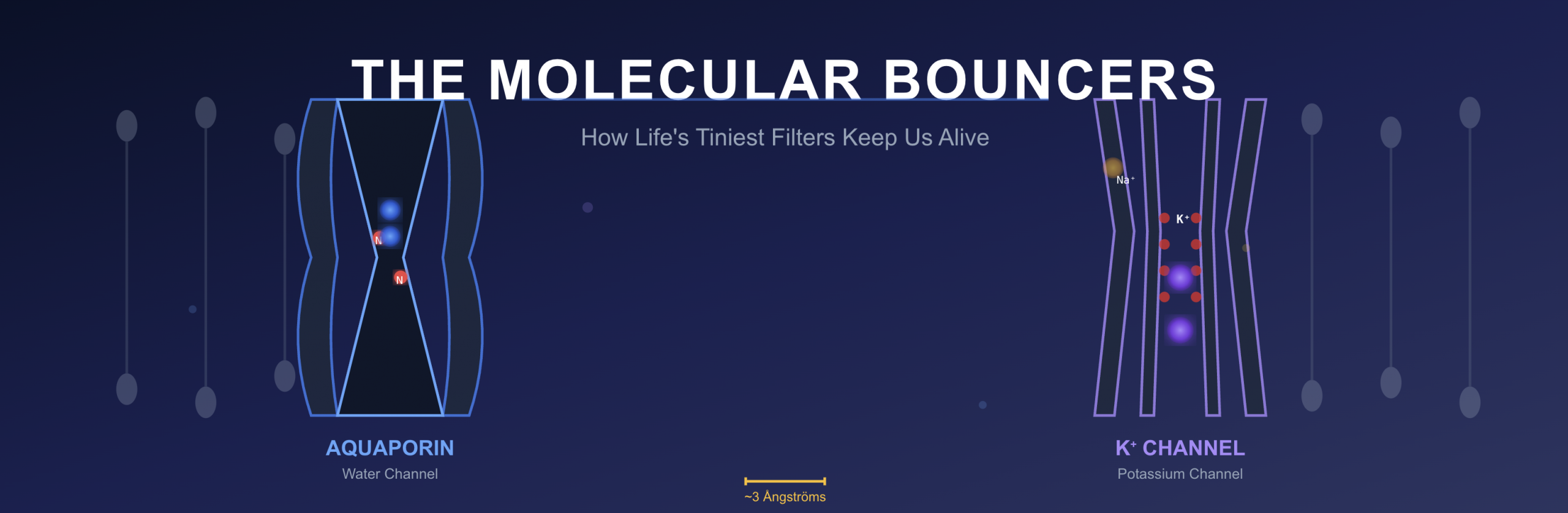
When researchers finally crystallized aquaporin in 2000, they saw an hourglass. Six alpha-helices loop through the membrane, forming a channel that’s wide at both ends but constricted in the middle—narrow enough that water molecules must pass single-file.
The first checkpoint is the ar/R filter, a cluster of bulky and positively-charged amino acids, including arginine. The positive charge repels lone protons electrostatically while the bulky residues physically narrow the passage to exactly one water molecule’s width. It’s like installing a turnstile that only admits one person at a time while electrically shocking anyone trying to sneak through.
But the real masterpiece comes next: the NPA motif.
Two asparagine residues point toward each other from opposite sides of the channel, creating a molecular gauntlet. As a water molecule passes the ar/R filter and approaches the channel’s midpoint, it hydrogen-bonds with the first asparagine. Then—in a fraction of a nanosecond—the local electric field forces the water molecule to flip 180 degrees and bond with the second asparagine facing the opposite direction.
This forced rotation breaks the water molecule away from any protons that might be riding along. It’s an atomic-scale ejection seat, triggered billions of times per second with perfect reliability. Protons, which would normally hop along chains of water molecules like stepping stones, find themselves stranded. The chain breaks, and they can’t proceed.
Humans have thirteen different aquaporins, each fine-tuned for different tissues and purposes. Kidney cells alone deploy nine variants. Some transport glycerol. Others may shuttle gases like CO₂, NH₃, or even O₂. Each is a masterclass in evolutionary engineering—taking the same basic hourglass blueprint and tweaking it for specialized tasks.

The Sodium-Potassium Problem
If aquaporins solved the water-versus-proton problem, potassium channels tackled something even more counterintuitive: How do you separate two ions that are nearly identical?
Sodium (Na⁺) and potassium (K⁺) both carry a single positive charge. Their sizes differ by less than half an angstrom—about the width of a single atom. Yet potassium channels achieve 10,000-fold selectivity, allowing K⁺ to flood through at rates of 100 million ions per second while rejecting nearly all sodium.
This selectivity is literally a matter of life and death. After a neuron fires, potassium channels must open to restore the resting potential. If sodium leaked through instead, the neuron couldn’t reset. Your brain would be unable to process information. Muscles couldn’t contract reliably. The electrical grid of your nervous system would short-circuit.
The story of how scientists discovered this mechanism reads like a detective novel spanning six decades.
From Squids to Shaking Flies
In the 1940s, Alan Hodgkin and Andrew Huxley made a bold choice: study the squid giant axon. This nerve fiber, which helps squids execute their jet-propulsion escape response, is enormous by neuronal standards—thick enough to insert electrodes directly. Using their ingenious voltage-clamp technique, they discovered that action potentials resulted from a fast sodium influx followed by a slower potassium outflow.
They won the Nobel Prize in 1963, but they never identified the proteins responsible. That required waiting for molecular biology to catch up.
The breakthrough came from an unexpected source: fruit flies with a curious mutation. When anesthetized with ether, these flies’ legs shook uncontrollably—hence the gene’s name, “Shaker.” By the 1980s, researchers had cloned the Shaker gene and discovered it encoded a voltage-gated potassium channel. Finally, Hodgkin and Huxley’s predictions had molecular proof.
In 1998, Roderick MacKinnon’s team at Rockefeller University solved the protein’s structure, revealing how it achieved its remarkable selectivity.
The Oxygen Cage
Normally, potassium ions float in water surrounded by a hydration shell—a sphere of water molecules arranged in a specific geometry. Stripping this shell away costs energy. But the potassium channel’s interior is lined with oxygen atoms positioned via structures called P-loops, arranged to perfectly match the geometry of a dehydrated K⁺ ion.
When potassium enters the channel, it sheds its water shell and slots into the oxygen cage like a key in a lock. Sodium, being slightly smaller, can’t make contact with all the surrounding oxygens simultaneously. It’s like trying to grip a basketball with hands too small—the geometry just doesn’t work. So sodium stays hydrated and gets excluded.
But this explains only selectivity, not speed. How does the channel maintain such a phenomenal throughput?
The answer emerged when researchers crystallized the channel with rubidium and cesium—potassium-like ions that scatter X-rays more strongly. The images revealed something unexpected: the channel holds four potassium ions simultaneously, spaced about 3 angstroms apart and stabilized by the oxygen atoms lining the channel.
At this distance, the positively-charged ions repel each other. The channel harnesses this repulsion as a propulsion mechanism. When a new K⁺ ion enters from one side, it electrostatically pushes the others forward like a line of magnetic balls, ejecting the ion at the opposite end. This “knock-on” mechanism transforms electrostatic repulsion into continuous flow.
It’s an atomic-scale Newton’s cradle, operating at rates that would make any mechanical system melt down.
Elegance in Simplicity
What strikes me most about these molecular filters isn’t their complexity—it’s their simplicity.
Evolution didn’t solve these problems with elaborate clockwork mechanisms or energy-intensive pumping systems. It solved them with geometry and charge, arranged with atomic precision. Place an arginine here, position some oxygens there, space them exactly 3 angstroms apart—and suddenly you have a machine that can distinguish between ions differing by fractions of a nanometer while operating at rates approaching the speed of diffusion itself.
There’s something almost austere about this approach. No moving parts. No fuel consumed beyond the energy already invested in building the protein. Just the right atoms in the right places, letting physics do the work.
It reminds me of that perhaps-apocryphal J.S. Bach quote about the piano: “There’s nothing remarkable about it. All one has to do is hit the right keys at the right time and the instrument plays itself.” In biology, hit the right amino acids at the right positions, and the protein filters itself.
This principle—that positioning matters more than machinery—extends far beyond ion channels. Enzymes accelerate reactions by positioning substrates precisely. Ribosomes translate genetic code by positioning transfer RNAs exactly where they need to be. DNA polymerase achieves its remarkable fidelity by creating a pocket that only accommodates correctly paired nucleotides.
Biology, it turns out, is largely a story about putting things in the right place.
The Medical Implications
Understanding these channels has transformed medicine. Mutations in aquaporin genes cause conditions ranging from nephrogenic diabetes insipidus (where kidneys can’t concentrate urine) to congenital cataracts. Mutations in potassium channels underlie certain epilepsies, cardiac arrhythmias, and periodic paralysis disorders.
We’ve also learned to weaponize this knowledge. Many drugs work by blocking or modulating ion channels. Local anesthetics block sodium channels, preventing pain signals from propagating. Several blood pressure medications target potassium channels. Even some cancer treatments exploit channel dysfunction in tumor cells.
But perhaps the most exciting frontier involves not just understanding these channels but designing new ones.
The AI Revolution in Protein Design
For decades, determining protein structure required painstaking crystallography experiments that could take years. But in 2020, DeepMind’s AlphaFold cracked the protein folding problem, predicting three-dimensional structures from amino acid sequences with stunning accuracy. In 2024, they released AlphaFold 3, which can now predict how proteins interact with ions, small molecules, and other proteins.
This isn’t just about prediction—it’s about creation. AI tools are now helping researchers design entirely novel ion channels, optimized for specific tasks. Want a channel that conducts calcium but blocks magnesium? Need a water channel that also transports a particular drug molecule? These are no longer thought experiments; they’re active research programs.
We’re entering an era where we don’t just study evolution’s designs—we iterate on them. The same principles that evolution discovered over billions of years can now be applied deliberately, with machine learning helping us navigate the vast space of possible protein configurations.
Imagine biosensors built from engineered channels that change conductivity in response to specific biomarkers, enabling real-time disease monitoring. Or targeted drug delivery systems using modified aquaporins to shuttle therapeutics directly into specific cell types. Or even entirely synthetic cells, built from the ground up with designer channels optimized for industrial bioproduction.
The geometry-is-destiny principle that governs natural channels may soon underpin an entire generation of synthetic biology applications.
A Conversation Worth Having
These discoveries—from Agre’s aquaporins to MacKinnon’s potassium channels to AI-designed synthetic variants—represent more than scientific achievement. They represent a shift in how we understand life itself. We’re moving from observation to comprehension to engineering.
This intersection of structural biology, evolutionary insight, and computational design is precisely why we’ve made it a central theme in our upcoming town hall discussions at GlobalHealthCongress.com. When you bring together experts who’ve spent careers studying these molecular machines with computer scientists training AI on protein structures, with physicians treating channel-related diseases, with bioengineers designing synthetic versions—that’s when genuinely transformative insights emerge.
Global health isn’t just about vaccines and epidemiology, crucial as those are. It’s about understanding life at every scale, from atomic filters in cell membranes to population-level health interventions. The same precision thinking that helps us understand how a single amino acid determines ion selectivity can inform how we design more effective drugs, diagnostic tools, and therapeutic approaches.
We need venues where structural biologists can talk to AI researchers, where basic scientists can connect with clinicians, where the person who solved a crystal structure can meet the person who’s using that structure to design the next generation of treatments. That cross-pollination of deep expertise—that’s where breakthroughs hide.
The Poetry of Precision
There’s something profound about realizing that your consciousness right now—every thought, memory, and sensation—depends on these tiny filters making trillions of correct decisions per second. As you read this sentence, potassium channels in your visual cortex are opening and closing, resetting neurons so they can fire again. Aquaporins in your retinal cells are maintaining exactly the right water balance for your vision to stay sharp.
You are, in a very literal sense, held together by geometry.
The cell membrane is perhaps the oldest invention of life, dating back to the very first protocells billions of years ago. Those early membranes were likely leaky and imprecise. But over vast stretches of time, evolution refined them, adding channels that could distinguish between molecules with increasing precision, until finally arriving at filters so exquisite they can separate ions differing by fractions of a nanometer while operating at speeds approaching physical limits.
We are the descendants of those early cells, carrying forward their molecular innovations, refined across billions of generations.
And now, understanding how those innovations work, we’re beginning to add our own designs to the repertoire. We’re learning to speak evolution’s language—the language of atomic precision, geometric constraint, and emergent function.
That feels like progress worth celebrating.
And definitely worth discussing.
Join us for our upcoming town hall at GlobalHealthCongress.com where leading researchers in structural biology, AI-driven protein design, and translational medicine will explore how atomic-scale discoveries are reshaping global health. Because understanding how life works at the smallest scales unlocks possibilities at the largest.
References & Further Reading:
- Agre, P. (2004). Aquaporin water channels (Nobel Lecture). Angewandte Chemie International Edition, 43(33), 4278-4290.
- MacKinnon, R. (2004). Potassium channels and the atomic basis of selective ion conduction (Nobel Lecture). Bioscience Reports, 24(2), 75-100.
- Jumper, J., et al. (2021). Highly accurate protein structure prediction with AlphaFold. Nature, 596(7873), 583-589.
- Hodgkin, A.L., & Huxley, A.F. (1952). A quantitative description of membrane current and its application to conduction and excitation in nerve. The Journal of Physiology, 117(4), 500-544.
